Yes, in most cases. Replacing a whole roof covering, or more than half of it, is work that building regulations apply to, and it has to be signed off either by building control or by a roofer registered with a government approved scheme. Repairs and small areas of re-covering normally need no application at all. The two things that most often bring a roof job inside the rules are the size of the area being replaced and a change to a heavier covering.
The part that surprises most people is what comes with it. When more than half a roof is stripped and re-covered, the regulations expect the insulation to be brought up to a modern standard at the same time, where that is reasonably possible. That is often the most useful thing the paperwork does for you.
Where the line sits
The Planning Portal sets out the government's guidance for work to an existing roof. You will not normally need a building control application to repair or re-cover a pitched or flat roof if the work affects less than 50 per cent of the roof and less than 25 per cent of the whole outside envelope of the house. Go beyond either of those and approval is needed.
The same guidance lists three other triggers that apply whatever the size of the job. Approval is needed for any structural alteration, for a new covering whose performance will be significantly different from the old one, and for a new covering that increases the weight of the roof covering by 15 per cent or more.
In practice that means replacing a few dozen slipped or cracked tiles, rebedding a ridge or renewing a flashing sits outside the rules. A full re-roof of a house, or of the main roof of a bungalow, sits inside them.
Why insulation comes into it
A roof that separates heated rooms from the outside is what the regulations call a thermal element. Regulation 23 of the Building Regulations 2010 says that where renovation covers more than 50 per cent of an element's surface, the whole element has to meet the energy efficiency standard, so far as that is technically, functionally and economically feasible.
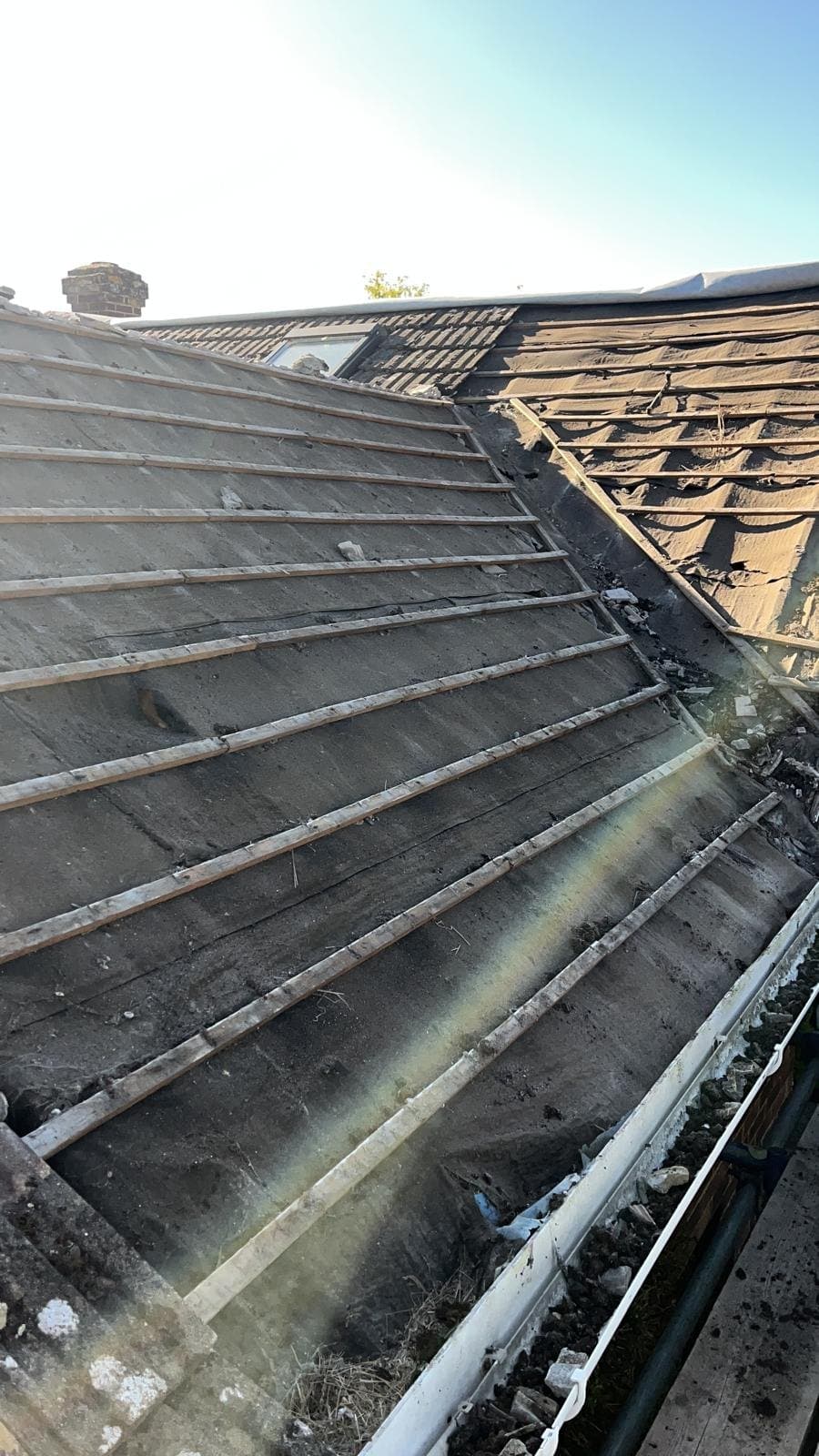
Stripping a pitched roof down to the rafters and rebuilding it counts as renovation, and so does replacing the waterproof membrane on a flat roof. A new layer laid purely as a repair to a flat roof does not. That is why a patch repair on a flat roof extension is outside the rules while a full new covering is not.
Approved Document L, the government's guidance on meeting the standard, puts the target for a renovated roof at a U-value of 0.16. For an ordinary house with a cold loft that usually means loft insulation of around 250mm laid between and across the ceiling joists, or topping up what is already there to that depth. Where the roof space is a room, the insulation goes between and below or above the rafters instead. If the full standard is not practical, the guidance asks for the best that is, judged by whether the cost pays back in fifteen years or less.
The same guidance asks for the condensation risk in the roof space to be assessed whenever insulation is added. More insulation keeps the loft colder, and a cold loft with nowhere for moist air to go grows damp on the underside of the felt. That is the link between this paperwork and the problems in how poor insulation affects a roof and roof ventilation problems.
A new edition of Approved Document L takes effect on 24 March 2027. For re-roofing it keeps the same 50 per cent trigger and the same 0.16 target, so a roof replaced next year faces the same expectation as one replaced this winter.
A heavier roof is a structural question
Changing what a roof is covered with is where the structure comes in. A roof built for one covering is not automatically strong enough for another, and the 15 per cent weight trigger exists because a heavier covering puts more load on rafters, purlins and walls that were sized for the old one. Swapping natural slate for concrete tiles is the usual example, and choosing between tile and slate covers why the two behave so differently.
Where the weight goes up, building control will want to see that the structure can carry it, which can mean calculations from a structural engineer and sometimes strengthening before the new covering goes on. A like for like re-roof avoids the question entirely, which is one reason it is usually the simpler route as well as the right one for an older house.
Two ways to get it signed off
The first route is the building control body. In Kent that is the district or borough council's building control team, so Ashford Borough Council for Ashford and Tenterden, and Folkestone and Hythe District Council for Hythe and the Marsh towns, never Kent County Council. Rye and Camber come under Rother District Council in East Sussex. A registered building control approver, a private alternative to the council, can also do it. Either way the work is notified before it starts and inspected, and you receive a completion certificate at the end.
The second route is a roofer registered with a competent person scheme. Under Schedule 3 of the Building Regulations, a replacement roof covering can be self certified by a roofer registered for that work with NAPIT or with the National Federation of Roofing Contractors, whose scheme is called CompetentRoofer. GOV.UK keeps the list of authorised schemes. The registered roofer must give you a certificate and tell building control within 30 days of finishing, with no separate application from you.
Both routes end with a certificate, and that piece of paper is the point. Ask whoever is quoting which route they will use, and who is paying for it. We raise building regulations sign off with you at quote stage on any full re-roof, so the cost and the route are on the quote rather than discovered halfway through.
Planning permission is a separate question
Building regulations decide how the work is done. Planning decides whether it can be done at all, and the two are completely independent. Most re-roofing that keeps the same look needs no planning permission, which our planning permission guide covers in full.
A few places change that. A listed building needs listed building consent for roof work that affects its character, whatever building regulations say. In Rye, an Article 4 direction in the conservation area means changing the roofing materials on a house facing a road or open space can need planning permission when it would not elsewhere. Both of these sit on top of the building regulations, not instead of them.
What happens if nobody signs it off
A re-roof without a certificate usually surfaces when you sell. The buyer's solicitor asks for paperwork for any major work, and a whole new roof with nothing to show for it raises questions about how it was built, which identifying poor roof installation shows can be hard to answer from the outside.
It can also be enforced. Under section 36 of the Building Act 1984, the building control authority can require work that breaks the regulations to be altered or taken down, and since October 2023 it has had up to ten years from completion to do so in England. A retrospective application, called regularisation, is possible through the council, but it usually means opening the work up for inspection, which on a finished roof is neither cheap nor tidy.
Replacing a roof without the paperwork worries
If your roof is due for replacement, talk to Premier Roofing and Building Kent Ltd before you compare prices, because a quote that leaves out sign off and insulation is not the same job as one that includes them. We will look at the roof, tell you whether it needs replacing or repairing, and set out the sign off route and the insulation work in writing alongside everything else.
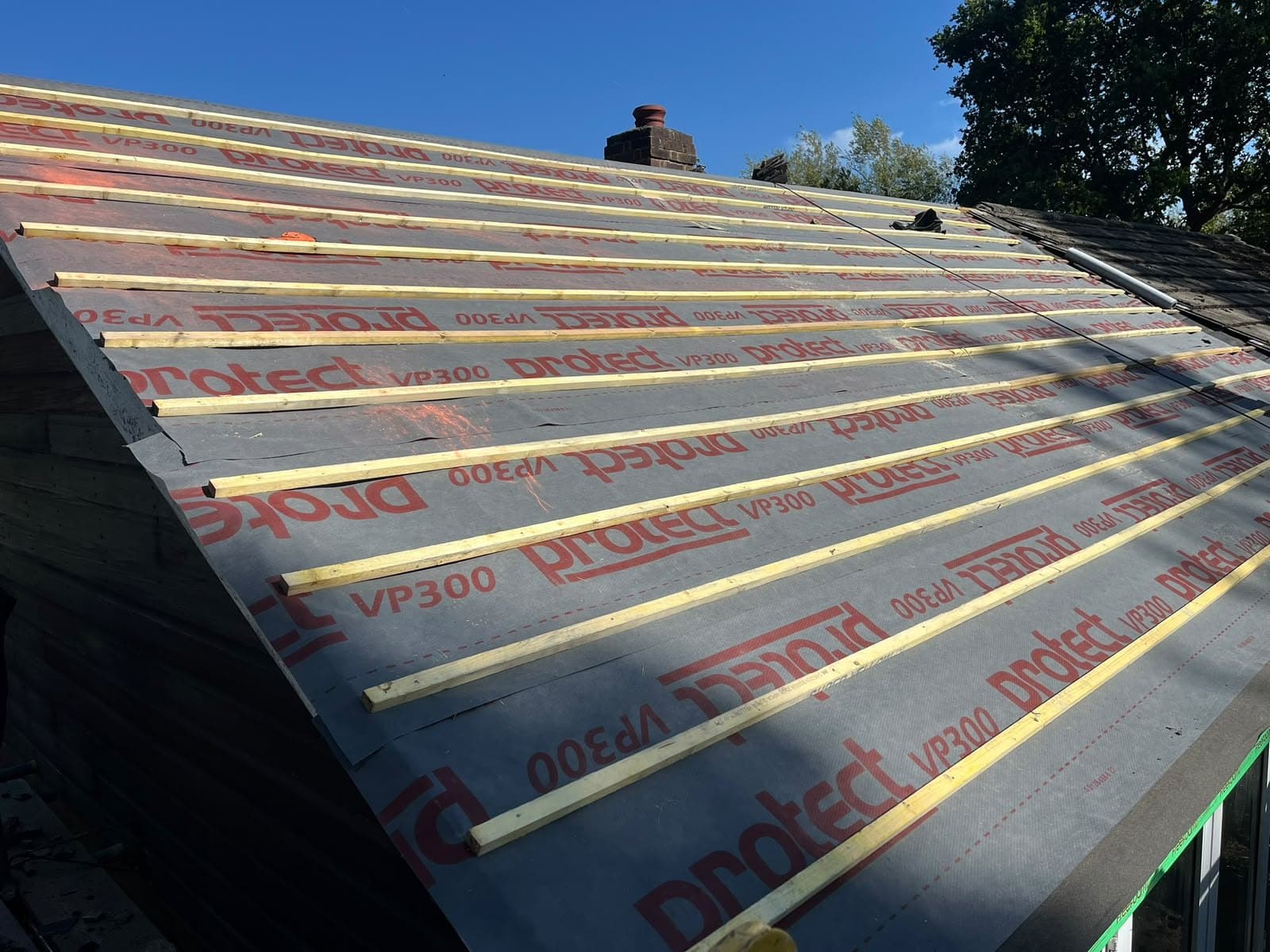
Our new roofs and felt and batten work covers the full strip and rebuild, and what a full roof replacement involves explains each stage. Quotes are free, itemised and carry no obligation, our workmanship is backed by a one thousand pound guarantee, and our verified reviews are on our Checkatrade profile. See finished re-roofs in our gallery, then call 01233 234554, email premier_roofing@hotmail.com or contact us. We cover Ashford, Tenterden, Romney Marsh, Hythe, Rye and the coast.