Choosing between tile and slate roofing comes down to four things, and only one of them is taste. What the roof structure will carry, what pitch the roof actually has, what the property and the street around it are, and what you want the roof to cost across its whole life rather than on the day it goes on. Get those four straight and the decision usually makes itself.
The short version is that slate is lighter per square metre but needs more of it, more fixings and generally a steeper pitch, and it lasts a very long time. Interlocking tiles are heavier per unit but cover far more area each, go on faster, cost less and suit shallower pitches. Neither is better in the abstract. What matters is whether your particular roof can take it, and that is a question about your building rather than about the material.
Start with what the roof can carry
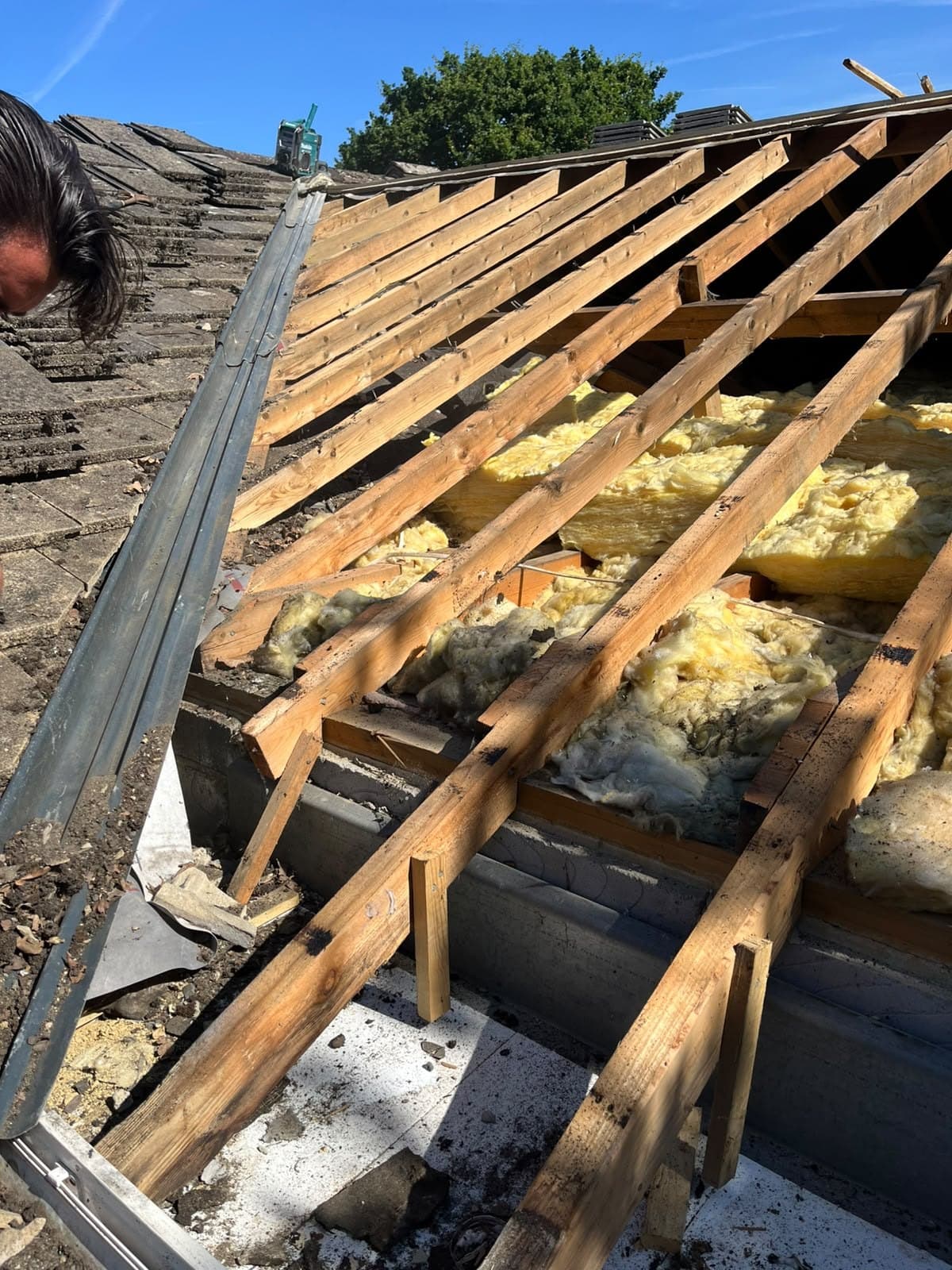
The structure decides more than anything else. A roof built for lightweight slate will not necessarily take heavy concrete interlocking tiles without the timbers being checked and sometimes strengthened, and going the other way is easier but still worth confirming.
This is why a proper survey matters before the material conversation, not after it. We look at the rafter sizes, the spacing, the purlins and the wall plate, ideally from inside the loft, because the answer is up there rather than in a brochure. Anyone who quotes you a covering before they have looked at what is holding the old one up is guessing.
Then the pitch, because it can rule one out entirely
Every roof covering has a minimum pitch below which it will not keep water out, and that figure comes from the manufacturer for the specific product rather than from a rule of thumb. In broad terms slate wants a steeper roof than most interlocking tiles do, and a shallow roof can quietly rule slate out before anyone has discussed how it looks.
The reason is in how each one sheds water.
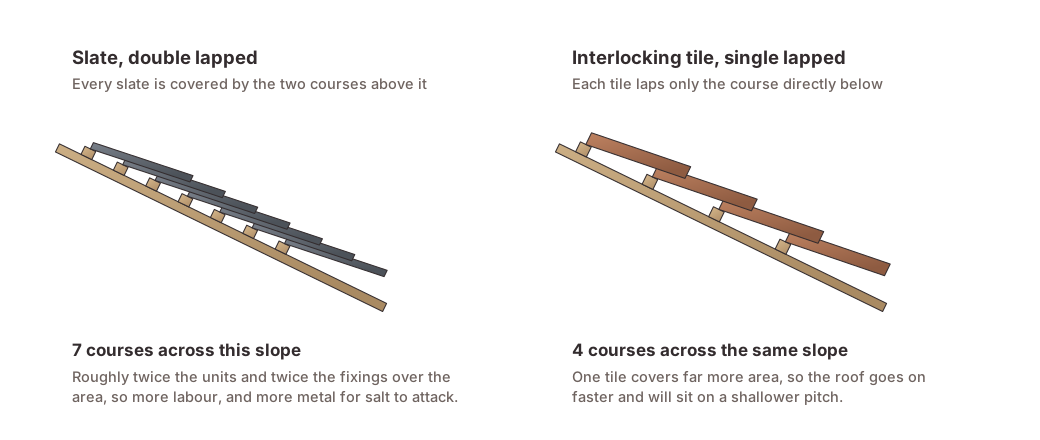
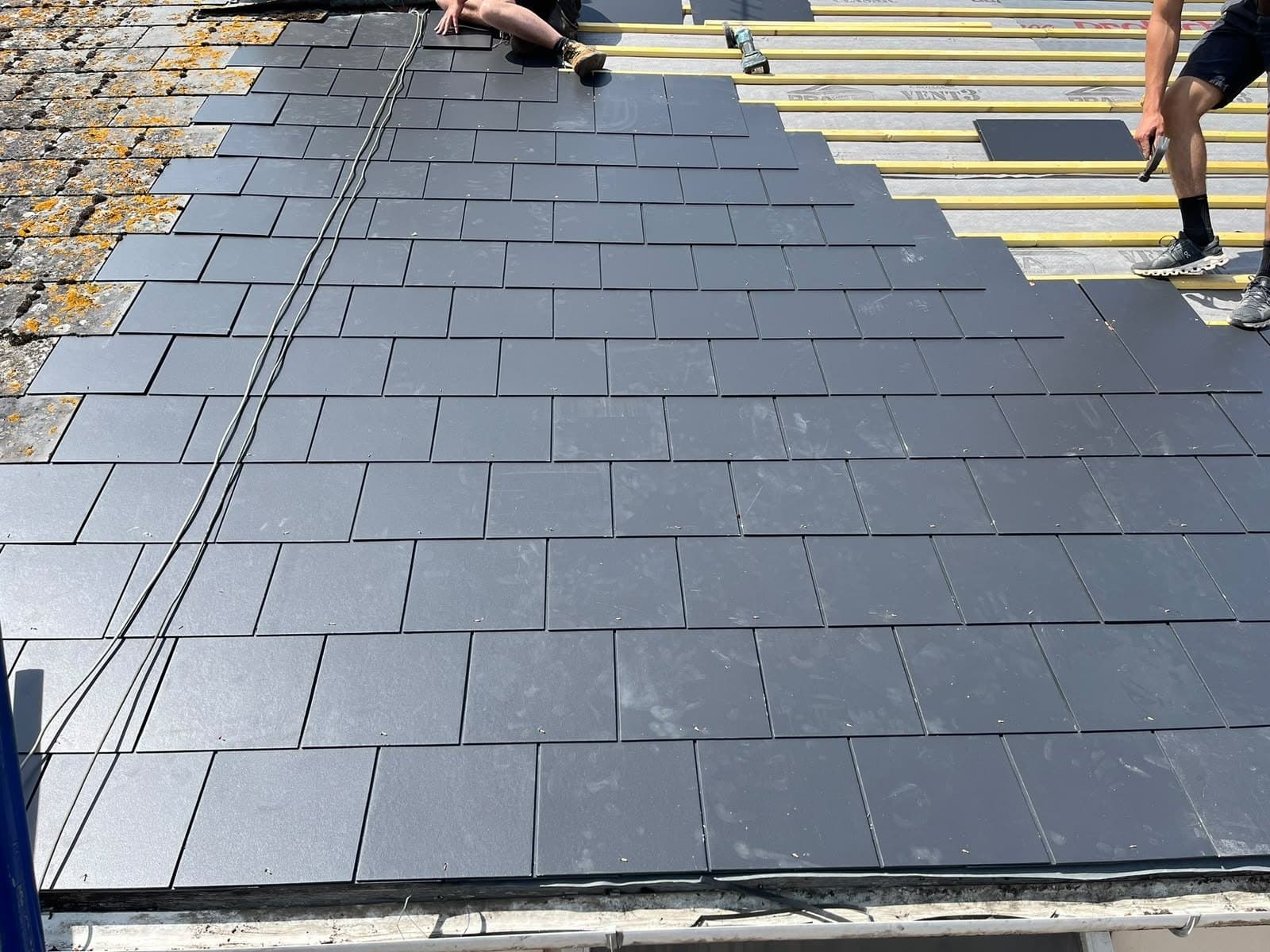
Slate is double lapped, meaning every slate is covered by the two courses above it, so the joint between two slates always has solid material over it. That is what makes slate watertight, and it is also why a slate roof needs roughly twice as many units, twice as many fixings and more labour than a tiled roof of the same size. Interlocking tiles do the same job differently, using a moulded side channel and a head lap, which is why one tile covers so much more area and why the roof goes on faster.
That single difference explains most of the cost gap and most of the weight and pitch differences too, which is why it is worth understanding before anyone talks price.
What each one actually is
Slate splits into natural slate and fibre cement substitutes. Natural slate is quarried stone and lasts generations. Fibre cement slates are manufactured, more uniform, cheaper and lighter, and they are a reasonable choice on the right building.
In our experience, natural slate works better than a fibre cement substitute on a house you intend to keep, because the substitute lays consistently and saves money on the day, but it weathers to a flatter colour and reaches the end of its life while the natural slate beside it is still perfectly sound. On a rental or a short hold, the sums can point the other way, which is a legitimate answer rather than a compromise.
Tiles split much the same way. Clay tiles are the traditional Kent covering, they weather beautifully and they hold their colour because the colour is the material. Concrete tiles cost less, come in more profiles and are heavier, and their surface colour fades over a couple of decades while the tile itself carries on. Which material suits a UK home depends far more on the building than on any league table.
Cost across the life, not on the day
A slate roof costs more to lay and lasts longer. A concrete tile roof costs less to lay and will want replacing sooner. Comparing them on the quote alone answers the wrong question.
Worth pricing properly rather than guessing, because what a full replacement costs varies far more with specification and access than with the covering alone, and scaffolding does not care what you put on top of it. It is also worth being realistic about how long each option genuinely lasts rather than trusting the longest number in the marketing.
What the coast does to the choice
This is where a decision made in a showroom goes wrong locally. Our patch runs from sheltered inland Ashford out to the exposed coast at Hythe, Dymchurch and Lydd, and the same covering behaves very differently at each end.
Salt air corrodes ferrous fixings far faster than inland air. On a slate roof that matters twice over, because slate needs roughly double the fixings of a tiled roof, so there is twice as much metal in the roof waiting to be attacked. We fit stainless as standard on exposed coastal work for exactly that reason, and on a coastal slate roof it is not optional in our view.
Wind matters too, and not the way most people expect. Wind pulls upward on a roof rather than pressing down, and the suction is fiercest at the eaves, the verges, the corners and the ridge, which is why storm damage almost always starts at an edge. On an exposed roof the edge detail and the fixing specification do more for longevity than the choice between tile and slate ever will.
What the house and the street are
Some of this is not really your decision. In a conservation area, or on a listed building, the covering may be effectively fixed, and changing the appearance of a roof can affect what falls under permitted development. The Planning Portal's guidance on roofs is the place to check before committing.
Even where nothing is formally protected, it is worth looking down your own street. A slate roof in a run of clay pantiles reads as a mistake for the next thirty years, and matching the local grain usually costs nothing and looks better. Independent guidance on standards and on choosing a roofer is available from the NFRC if you want a second opinion that is not selling you anything.
How we would approach it
We work in both, and we say so plainly rather than steering everyone toward whichever we prefer laying. Our 44 listed roofing skills cover pitched and flat roofs and tiled and slate work, and we hold ten out of ten across every review on our Checkatrade profile since joining in September 2024, on jobs including roof replacement across TN25, TN26 and ME14.
What we would do is look at the structure and the pitch first, tell you honestly which options your roof can actually take, then talk about appearance and budget within that. If slate is off the table because of the pitch, you should hear that in the first ten minutes rather than after you have fallen for it. Whatever goes on, the edges and the leadwork at the valleys and abutments matter more than the covering, and keeping on top of ordinary maintenance will add more years than the material choice will.
Talking to us
Premier Roofing and Building Kent Ltd is family run, owned by Ken Perkins and working out of Shadoxhurst just outside Ashford, covering Romney, New Romney, Dymchurch, Lydd, Hythe and Ashford. Between us we have over ten years in the trade, and we take on domestic and commercial work including insurance work.
Quotes for a new roof are free, itemised in writing and carry no obligation, our workmanship is backed by a one thousand pound guarantee, and there is a 24 hour call-out for genuine emergencies. Tiled and slated roofs we have completed across the patch are in our gallery if you want to compare them on real houses rather than in a brochure. To arrange a proper look, call 01233 234554, email premier_roofing@hotmail.com or send us a message.