Poor insulation damages a roof in a way most homeowners never see coming, because the damage is not caused by cold. It is caused by damp air. Warm, moist air from the house rises into the loft, meets the cold underside of the roof, and condenses there. Do that every night for a winter and you get wet insulation, damp timber, rusting fixings and a stain on the bedroom ceiling that looks exactly like a leak.
The counterintuitive part is that adding more insulation often makes it worse rather than better. The commonest fault we find in a loft is not too little insulation, it is insulation pushed too far, packed hard into the eaves where it blocks the ventilation gap the roof depends on. The house gets warmer, the roof stops breathing, and the moisture that used to escape now has nowhere to go. What follows is how to tell whether that is what is happening in yours.
The difference between a leak and condensation
These two produce the same symptom and need completely different work, so it is worth being able to tell them apart before anyone quotes you for tiles.
A leak follows the weather. It appears during or shortly after rain, it usually shows in the same spot each time, and the water has a path you can trace. Condensation does the opposite. It shows up in cold, dry, still weather, often after a clear frosty night, and it is usually worst above a bathroom, a kitchen or a utility room, because that is where the moist air is coming from.
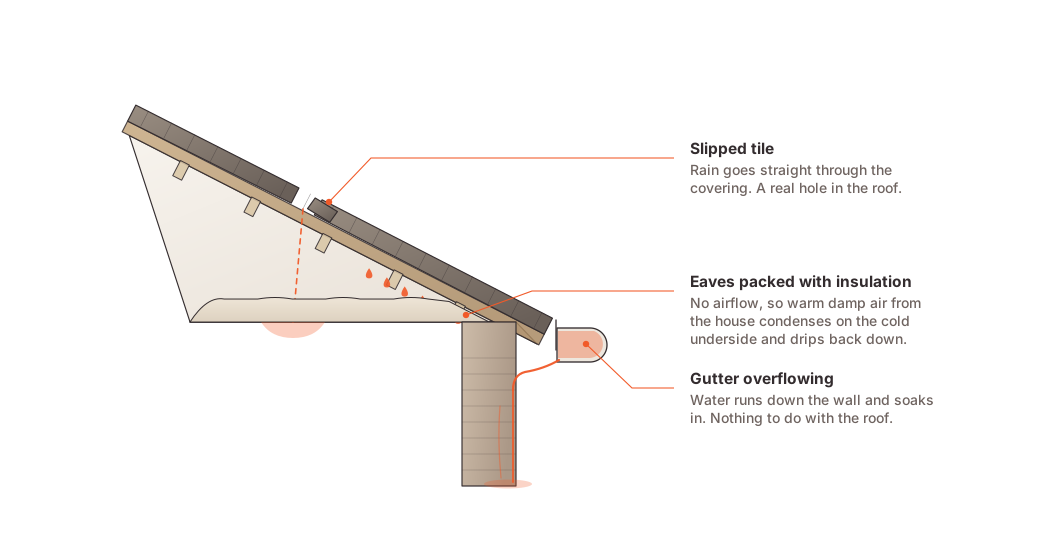
If you go into the loft on a cold morning and find droplets on the underside of the membrane, damp patches on the top of the insulation rather than underneath it, or rusty nail points, that is condensation rather than rain. Working out what a real leak looks like first will save you paying for the wrong repair, and if the roof itself is sound then no amount of work on the covering will fix it.
Why blocking the eaves is the fault we find most
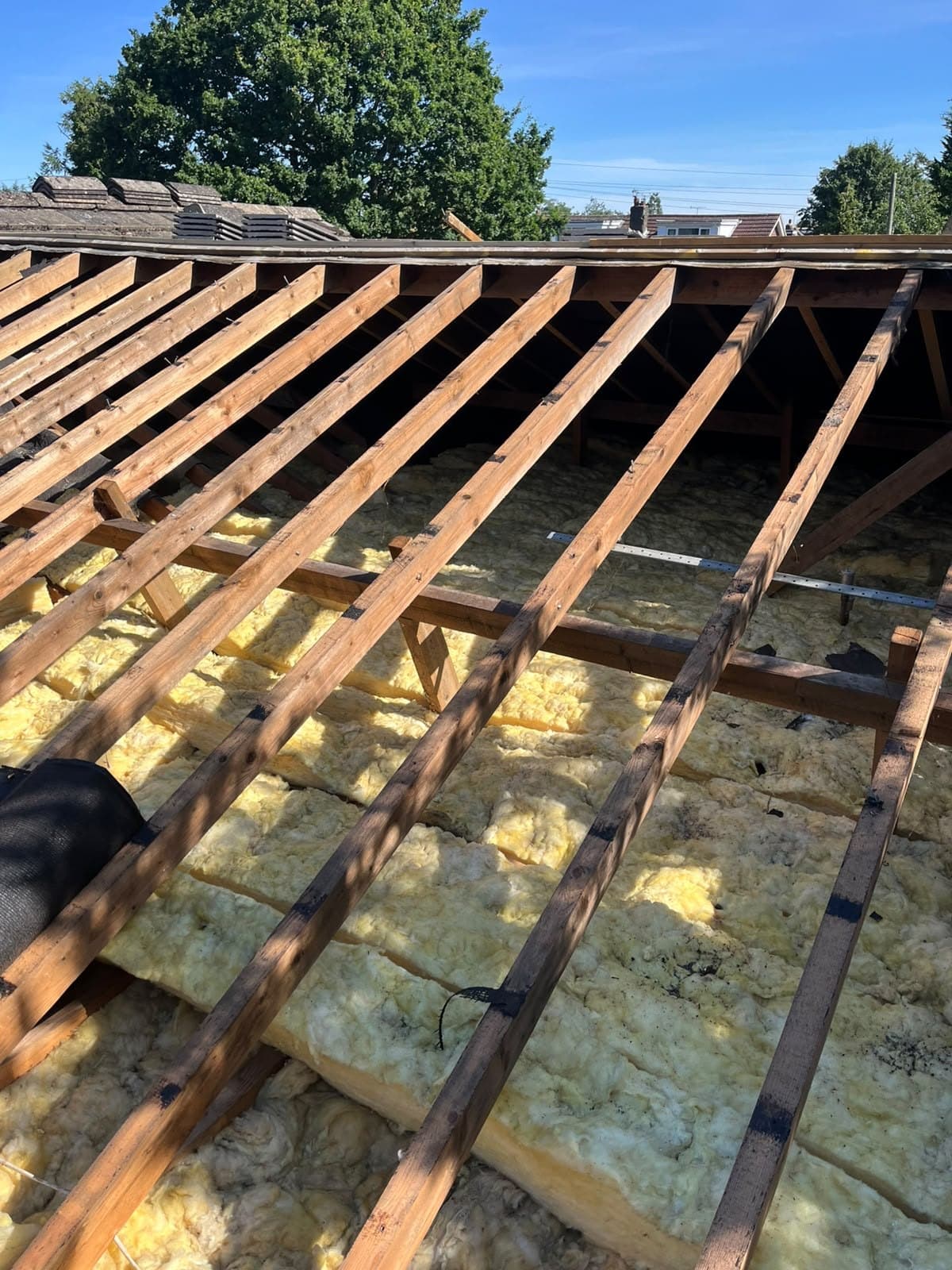
A cold loft is supposed to be ventilated. Air comes in at the eaves, moves up under the roof and carries moisture away with it. That airflow is what keeps the timber dry, and it needs a clear gap at the bottom of the slope to work.
When insulation is rolled out and pushed right to the edge, that gap disappears. It is an easy mistake to make, because tucking it in tight feels like doing a thorough job, and a lot of loft insulation has been installed by people paid by the square metre rather than the result. The correct answer is to stop the insulation short, or to fit eaves vents that hold the gap open regardless of what is pushed against them.
Ventilation requirements for roofs are set out in the government's Approved Document F, which is the standard any competent installer should be working to. In practice the tell is simple. Lie down at the edge of the loft with a torch and look for daylight at the eaves. If there is none, the roof is not breathing.
What it does to the roof over time
Condensation is slow and it is cumulative, which is why it does so much damage before anyone acts.
Wet insulation stops insulating almost entirely, so the problem compounds itself and your heating bill goes up while the loft gets damper. Damp timber is what rot needs to start, and rafters and battens that stay wet through a winter will soften at the ends first. Fixings corrode, which matters more than it sounds, because the nails and clips holding tiles down are exactly what stops wind lifting them off an edge. And any mould in the loft is a health matter rather than only a building one.
In our experience, opening the eaves back up and fitting proper vents works better than simply adding more insulation on top, because more insulation makes the loft colder and the underside of the roof colder still, so unless the air can move you have made the condensation worse while feeling like you solved something. The airflow has to come first. Then the depth.
Two other things that push moist air into a loft
Insulation is usually the constraint, but it is rarely the only cause, and fixing the airflow without fixing the source only gets you halfway.
Bathroom and kitchen extractor fans that vent into the loft rather than out through the roof or a wall are startlingly common, and they are the single largest moisture source we find. A fan ducted into a loft is putting every shower directly into the roof space. Loft hatches that do not seal, gaps around pipework and downlighters cut into the ceiling below all do the same thing more slowly.
If the loft smells damp, or the signs of a ventilation problem are already there, it is worth checking where the fans actually terminate before assuming the roof is at fault.
Why this shows up here in particular
Our patch runs from sheltered, tree-heavy inland Ashford out to the open coast at Dymchurch and Lydd, all within about twenty minutes of the yard at Shadoxhurst, and the housing here has been insulated in waves rather than all at once.
That matters because a great many roofs in this area were built long before current insulation depths were normal, and the extra was added later, into lofts designed around less of it. Retrofitted insulation is exactly the kind that ends up jammed into the eaves, because whoever added it was working to a depth rather than to a ventilation detail.
The coast adds a second problem. Salt air corrodes ferrous fixings far faster than inland air, so a Marsh roof already has less margin in its nails and clips than the same roof in Ashford. Add condensation dripping onto them all winter and that margin goes quickly. It is one of the reasons we fit stainless as standard on exposed coastal work.
Putting it right, and what it usually costs you
Most of the time this is a cheap fix caught early and an expensive one caught late, which is the whole argument for looking.
Clearing the eaves and fitting vents is modest work. Re-routing an extractor properly is modest work. What is not modest is replacing rafter ends and battens that have been wet for five winters, and by that stage you are into new felt and batten or a section of roof repair rather than a morning in the loft. Checking the roof to a routine catches it in the first category.
The useful habit is to go up into the loft on a cold, dry morning once a winter with a torch, rather than only after you see a stain. Condensation is visible up there long before it is visible downstairs.
Getting somebody to look
If there is a damp patch on a ceiling and no rain to explain it, the roof covering is probably not your problem and you should be careful of anyone who says otherwise without going into the loft.
Premier Roofing is family run, owned by Ken Perkins and working out of Shadoxhurst just outside Ashford, covering Romney, New Romney, Dymchurch, Lydd, Hythe and Ashford. Between us we have over ten years in the trade and list 44 separate roofing skills, and we have held ten out of ten across every review on our Checkatrade profile since joining in September 2024, on jobs across TN25, TN26 and ME14.
We look in the loft as well as on the roof, because that is where this particular problem is visible. Quotes are free and carry no obligation, our workmanship is backed by a one thousand pound guarantee, and there is a 24 hour call-out for genuine emergencies. Work from across the patch is in our gallery. To have your loft and roof looked at properly, call 01233 234554, email premier_roofing@hotmail.com or send us a message.