British weather damages a roof in five distinct ways. Wind lifts tiles by pulling upwards at the edges rather than pressing down on them, rain exploits junctions and gaps that dry weather keeps hidden, frost cracks anything porous that is holding water, summer heat and UV make felt and bitumen brittle enough to split, and long damp spells feed moss that traps moisture against the tiles. Almost every roof in this country meets all five within a single year, which is why a roof that looked perfectly sound in June starts dripping in November.
The more useful answer, and the one we would give you standing in your driveway, is that weather rarely destroys a roof in one event. It finds a weak point that was already there and works on it. A cracked mortar joint, a lifted flashing, a nail that has quietly corroded through, a gutter packed with silt. Storms take the blame because that is when the ceiling stain finally appears, but the damage was months or years in the making and one wet night simply finished the job. That matters, because it means most weather damage is preventable rather than inevitable.
Premier Roofing is a family run business based at Shadoxhurst just outside Ashford, run by Ken Perkins with over ten years in the roofing trade. Our patch gives an unusually clear view of this subject. Within twenty minutes of our yard we go from sheltered inland Ashford to the open Marsh at Dymchurch and Lydd, where a roof stands fully exposed to whatever the Channel sends at it. The same house, built the same way, ages completely differently in those two places. That contrast runs through everything below.
Wind is the biggest structural threat, and it pulls upwards
The most common misunderstanding we come across is that wind pushes a roof down. It does the opposite. Air accelerating over a pitched roof creates suction, and that suction is fiercest at the perimeter, so the eaves, verges, corners and ridge line carry the real load. This is why storm damage almost never starts in the middle of a slope. It lifts one component at an edge, then gets underneath everything around it.
Fixing standards changed for exactly this reason. BS 5534, the British Standard covering slating and tiling, was revised in 2014 so ridge and hip tiles must be mechanically fixed rather than held by mortar alone, a change the National Federation of Roofing Contractors pushed hard for. Plenty of roofs around Ashford and the Marsh predate that revision and still sit on bedding mortar that was never designed for the exposure it now faces.
In our experience, a mechanically fixed dry ridge system works better than a traditional mortar bedded ridge on exposed roofs because mortar is rigid and a roof is not. It moves constantly with heat and wind pressure, and a rigid joint on a moving structure eventually cracks. Once it does, water gets in, frost widens the crack, and the ridge tile is holding on by very little. A dry ridge is screwed to a batten and keeps holding long after the seal has aged.
We are not theorising here. Ridge work is one of the most frequent jobs we are called out to, and one of the verified jobs on our Checkatrade profile was a ridge replacement in TN26 where the bedding had let go. Another homeowner in TN25 noticed tiles had come down after weather, called us, and had a free quotation within twenty four hours. When storm damage does occur, the sooner the roof is made watertight the smaller the final bill, which is why we run a twenty four hour call out.
Rain gets in at junctions, not through the tiles
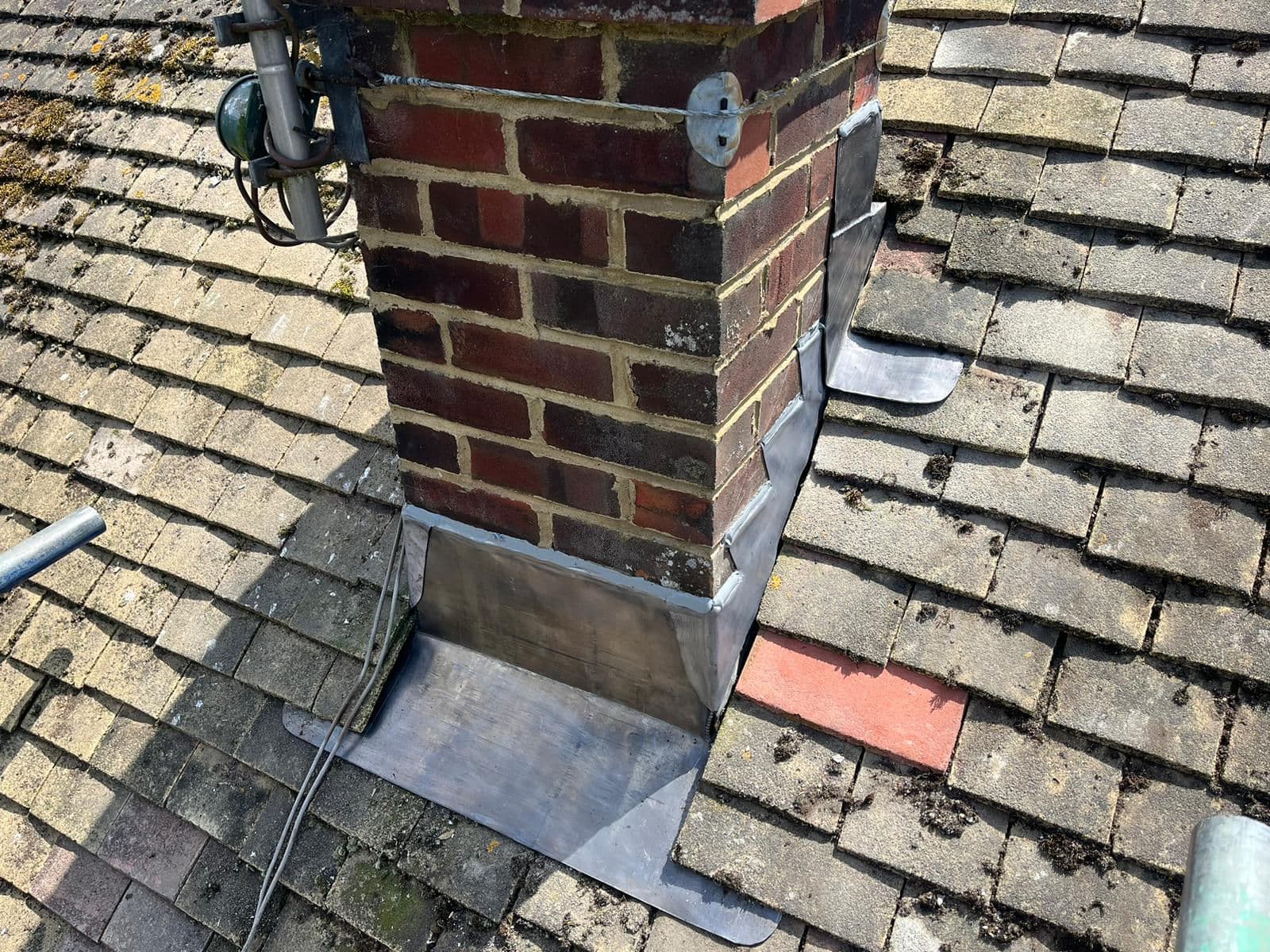
A sound tile sheds water perfectly well. Water gets in where two things meet. Chimney flashings, valleys, verges, abutments where roof meets wall, and around roof windows. Lead flashing at a chimney is the classic culprit, because a chimney is heated, exposed on all four sides and moves independently of the roof around it.
Gutters deserve more credit than they get. When a gutter overflows in heavy rain the water does not simply hit the ground. It runs down the fascia, soaks the soffit and tracks into the wall and roof timbers behind. From working with clients across Kent, we have found that a decent share of what gets reported to us as a roof leak turns out to be an overflowing or sagging gutter, which is a considerably cheaper conversation to have and one we are happy to have honestly.
Salt air is the factor almost nobody thinks about
This is where our part of Kent genuinely differs from the rest of it. Salt carried inland off the Channel settles on everything, and chloride accelerates corrosion of ferrous metals dramatically. Nails, clips and fittings that would comfortably last decades in Ashford give up years earlier in Dymchurch or Lydd. We have taken tiles off roofs after nothing more than a breezy week, purely because the fixings holding them had rusted through.
Salt attacks mortar too, and over time it undermines the same bedding that wind is already working on. If your property sits anywhere near the coast, this is the single biggest reason a roof there ages faster than an identical one a few miles inland.
Frost is slow, quiet and cumulative
Water expands as it freezes. Once it has soaked into mortar, pointing, a porous old concrete tile or a chimney stack, that expansion opens a hairline crack a fraction wider. Thaw, refill, refreeze, repeat. One winter changes very little. Ten winters change a great deal.
Freeze and thaw is the main reason roofs deteriorate in steps rather than smoothly, and it explains why chimney stacks and ridge lines are usually first to need attention. A chimney repair sits among our verified jobs for exactly this reason, and it is not a coincidence that our review record reads like a list of what British weather does to a roof.
Summer heat is harder on flat roofs than pitched ones
UV breaks down the binder in bitumen and felt. The material loses flexibility, goes brittle and splits, usually at upstands and joints where thermal movement concentrates. A dark flat roof surface gets far hotter than the air temperature on a clear day, then cools sharply overnight, and that daily expansion and contraction is what opens seams. Recent summers have made this noticeably worse, and felt roofs fitted with a twenty year expectation are not always reaching it. Most flat roof problems develop underneath the surface well before anything shows inside, which is why they tend to arrive as a surprise. A felt roof leak repair is another of the verified jobs on our profile.
Moss is the other slow burner, thriving on shaded north facing slopes and under overhanging trees. The problem is not the moss but the water it holds against the tile, which then feeds the freeze and thaw cycle. We would steer anyone away from pressure washing a mossy roof, because the pressure strips the protective granular surface off concrete tiles and forces water up under the laps. Careful removal takes longer and leaves the roof in a far better state.
The winter leak that is not a leak
Worth knowing before you call anyone, including us. Every winter we attend leaks that turn out to be condensation. Warm, moist air from the house rises into a cold loft, meets the cold underside of the roof, condenses and drips onto the insulation and the ceiling below. It looks exactly like a leak. The tell is that it appears in cold weather rather than during rain, and it is often worst above bathrooms and kitchens.
The usual cause is blocked airflow at the eaves, very often because loft insulation has been pushed tight into them. Ventilation requirements are set out in Approved Document F, and a roof that cannot breathe will rot its own timbers regardless of how good the tiles are. If you are seeing damp in the loft during cold dry weather, roof ventilation problems are a likelier explanation than a hole in the roof.
What actually helps
Two proper checks a year, in autumn before the weather turns and in spring after it has, will catch most of this. Clear the gutters before autumn. After any named storm, stand at ground level with binoculars and look along the ridge line and the verges, because that is where damage starts. Watch for slipped tiles, cracked ridge mortar, lifted flashing and any tile fragments in the garden. Do not climb up to check yourself.
Book a free roof check
If something needs attention, we would rather look and tell you the roof is sound than have you find out otherwise in December, and we have talked plenty of people out of work they did not need. Our quotes are free and carry no obligation, our workmanship is covered by a one thousand pound guarantee, and every verified review on our Checkatrade profile is rated ten out of ten. You can see the full range of roofing services we cover and the areas we work across, from Ashford out to Romney, New Romney, Dymchurch, Lydd and Hythe.
Call us on 01233 234554, email premier_roofing@hotmail.com, or get in touch through our contact page and we will come and look. Photographs of recent work are in our gallery and on our Checkatrade profile.
Understanding how weather conditions affect your roof in the UK really comes down to accepting that the damage is gradual and the weather is only ever the final step. Fix the weak point while it is small and the storm has nothing left to work with.