Protecting a roof from wind damage is almost entirely about the edges. Wind does not push a roof down, it lifts it, and the lift is fiercest at the eaves, the verges, the corners and the ridge. Get those four details fixed properly and a roof will ride out weather that strips its neighbours. Leave them on failing mortar and the first serious gale will find them.
So the practical answer is a short list. Make sure the ridge and hip tiles are mechanically fixed rather than bedded on mortar alone, make sure the verges are held down by something better than a strip of sand and cement, make sure the eaves course is clipped, and keep the gutters clear so nothing is adding dead weight to the most vulnerable line on the building. None of that is glamorous and all of it is cheaper than a re-roof.
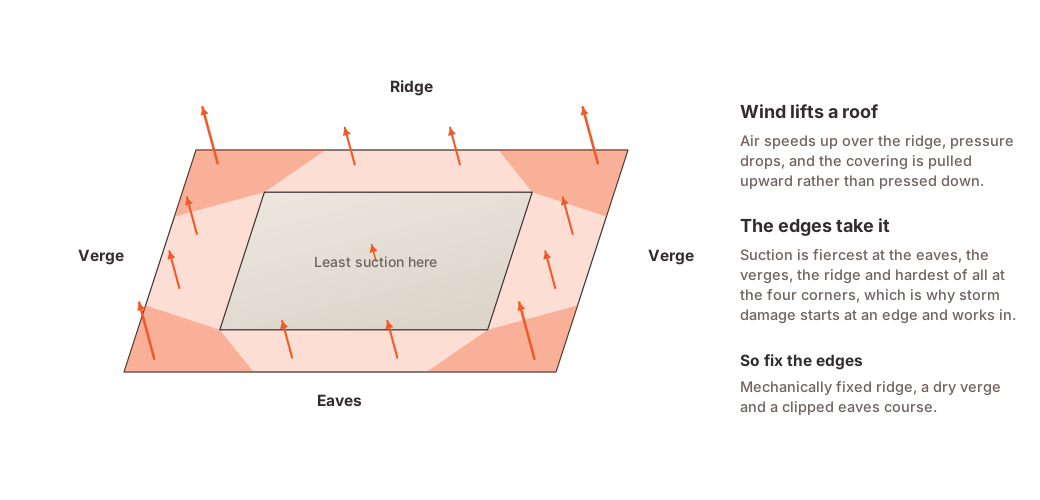
Why wind lifts a roof rather than pressing on it
Air moving over a pitched roof behaves like air moving over a wing. It speeds up as it crosses the ridge, pressure drops on the upper surface, and the roof is pulled upward. At the same time wind getting into the building or under the covering pushes outward from below. The two act together, which is why storm damage almost always starts at an edge and works inward rather than starting in the middle of a slope.
That is worth knowing because it changes what you spend money on. A roof with a perfectly sound middle and a loose verge is a vulnerable roof. From working with clients across Ashford, Romney Marsh and the coast, we have found that the vast majority of the damage we are called out to after a gale begins at an eaves course, a verge or a ridge line, and hardly any of it starts where people expect.
The ridge, which is where most local roofs are weakest
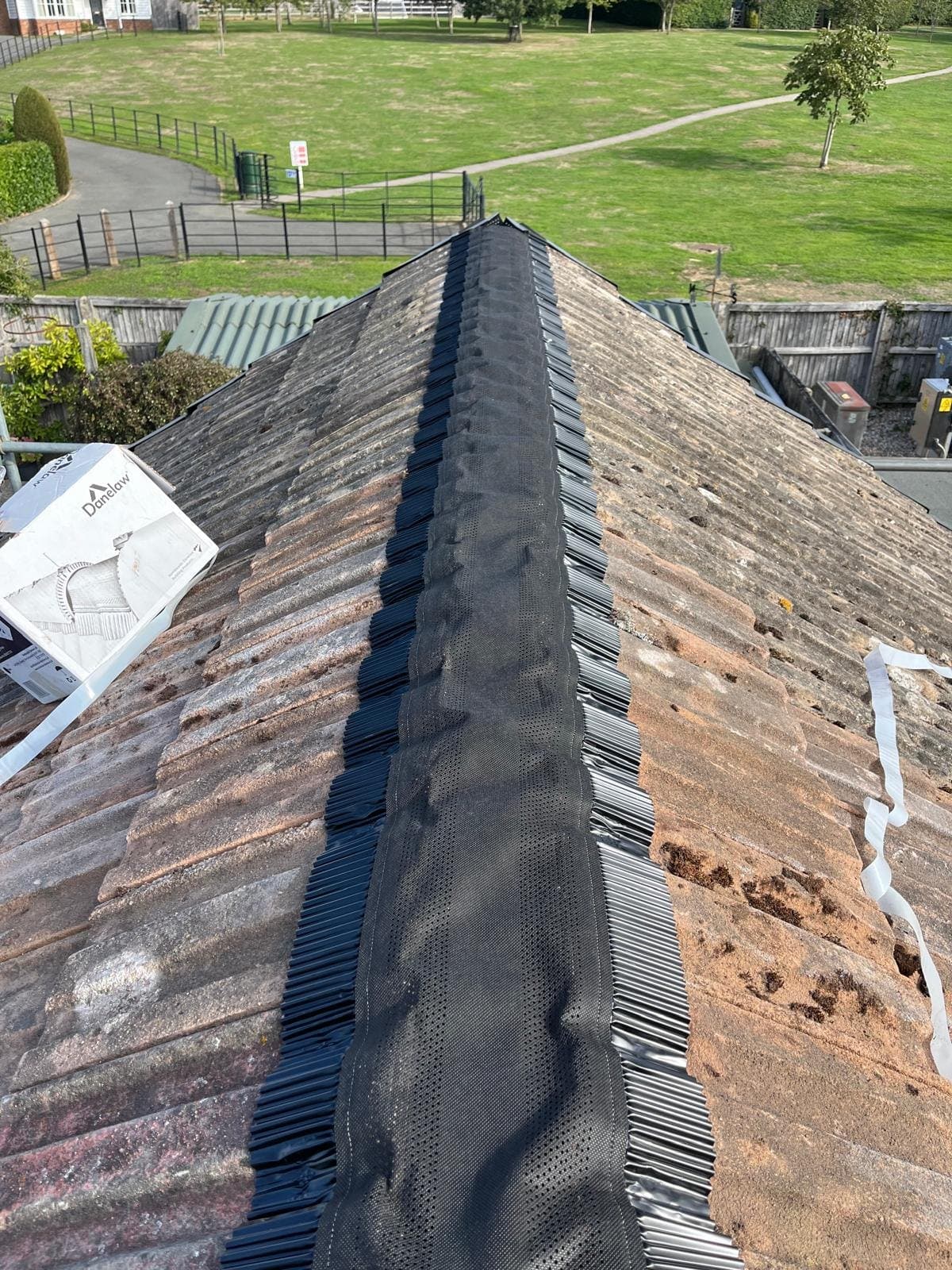
BS 5534 was revised in 2014 and now requires ridge and hip tiles to be mechanically fixed rather than held by mortar alone. A great many roofs around here predate that and are still relying on bedding mortar that has been freezing and thawing for decades. Freeze and thaw damage is cumulative and stepped rather than gradual, so a ridge can look acceptable for years and then let go of several tiles in one night.
This is the single most common job we are called to, and it is also the cheapest thing on this page to put right relative to what it prevents. Ridge tile replacement with proper mechanical fixings is a repair you do once, whereas repointing a mortar ridge is a repair you keep doing.
Verges, eaves and the corners
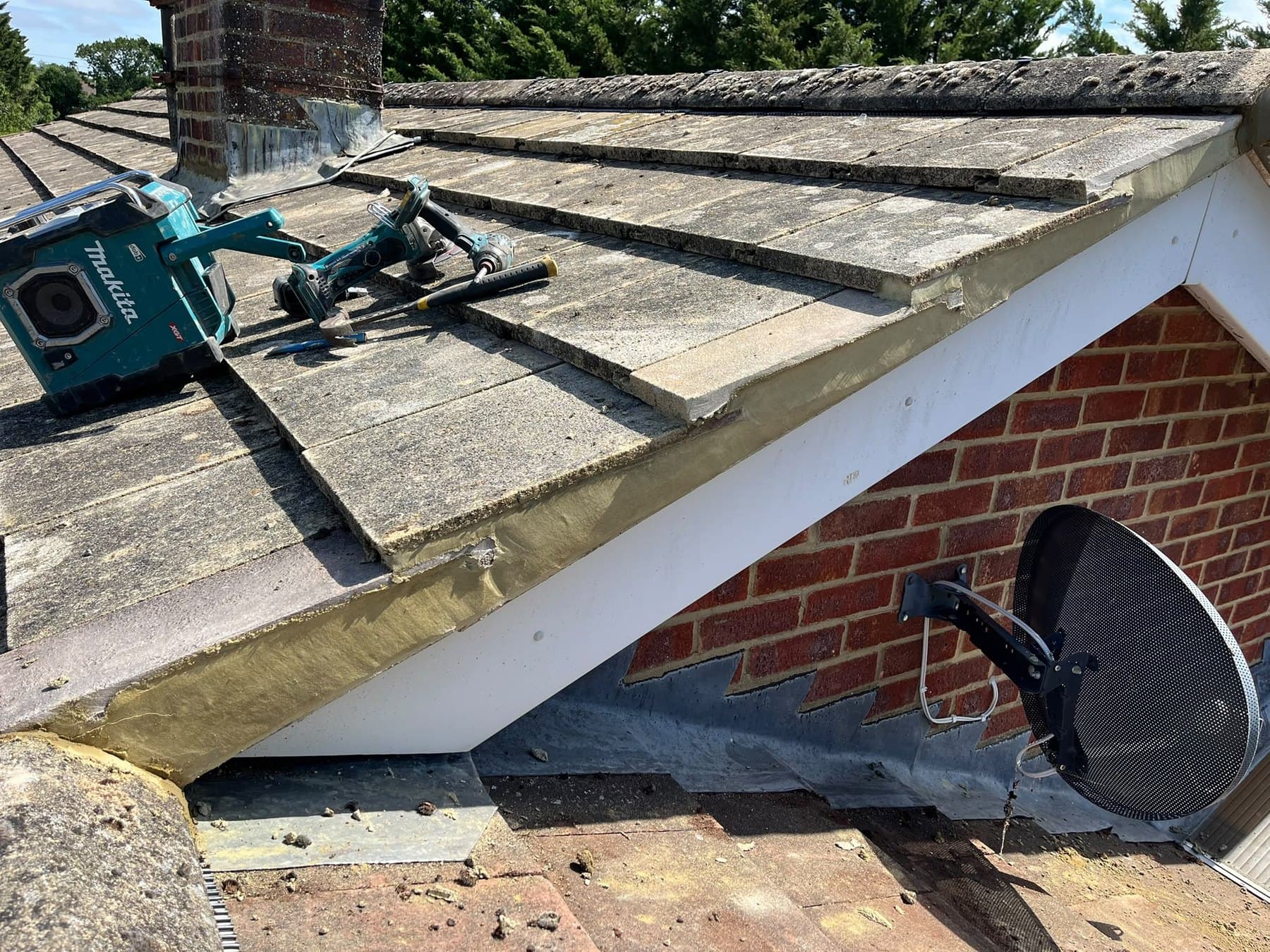
The verge is the sloping edge at a gable, and on older roofs it is usually a bed of mortar holding the last tile down. That mortar is doing a job it was never designed for. In our experience a dry verge system works better than mortar bedding on an exposed roof, because mortar resists uplift only while it is intact, and when it cracks it tends to release a whole run at once rather than one tile at a time, so you lose the edge of the roof in a single event instead of getting a warning.
The eaves course wants clipping too, because it is the first thing the wind gets under. Corners take the highest suction of anywhere on the building, which is why they are worth a proper look rather than a glance from the pavement.
Salt makes all of this happen sooner on the coast
Our patch runs from sheltered, tree-heavy inland Ashford out to the open coast at Dymchurch and Lydd, all within about twenty minutes of our yard at Shadoxhurst, and wind resistance behaves very differently at the two ends.
The reason is not just exposure, it is corrosion. Salt air eats ferrous fixings far faster than inland air, so the galvanised clips and nails holding an edge down on the Marsh give out years earlier than identical fixings in Ashford. A roof can therefore be perfectly well specified on paper and still fail at the edges, because the specification assumed the fixings would still be there. We fit stainless as standard on exposed coastal work for exactly this reason, and on a coastal roof it is the difference between a fixing detail that lasts the life of the covering and one that quietly disappears.
Keep the gutters clear, because weight matters
This one surprises people. A gutter full of wet debris is heavy, and it hangs off the fascia at the eaves, which is the line already taking the most uplift. Add a run of gales to a gutter carrying a season of wet moss and the brackets and the board behind them are being worked far harder than the gutter's own weight suggests.
Clearing them twice a year is ordinary maintenance rather than storm preparation, but it genuinely belongs on this list. Blocked gutters also overflow behind the fascia and rot the timber the eaves fixings are screwed into, which takes out the fixing detail from underneath.
What to do before and after a storm
Before, the useful work is the boring work. Have the ridge, verges and eaves looked at, get loose tiles refixed rather than waiting, and cut back anything overhanging that could come down on the covering. Most of this sits naturally alongside the rest of the autumn jobs, and doing them in one visit while access is already set up costs far less than three separate call-outs across the winter. Slipped tiles are worth dealing with in September rather than January, because a slipped tile is an opening for the wind to get underneath the course above it.
After, look from the ground and from inside the loft rather than going up. Binoculars from the garden and a torch in the loft will tell you most of what you need. Spotting storm damage properly is a job that can be done safely from below, and the HSE guidance on working at height is worth reading before anyone considers a ladder in a wind. If something has moved, we run a 24 hour call-out and customers on our verified reviews have picked out fast call-outs within 24 hours more than anything else.
There is also an insurance point worth knowing. Genuine storm damage is often covered, and we take on insurance work, so it is worth checking your policy before paying for anything yourself.
Getting the edges checked
Wind damage is not really about the weather, it is about whether the four edges of your roof are held down by fixings or by mortar. That is a question anybody can answer for you in half an hour on a ladder, and it is far better answered in autumn than in February.
Premier Roofing and Building Kent Ltd is family run, owned by Ken Perkins and working out of Shadoxhurst just outside Ashford, covering Romney, New Romney, Dymchurch, Lydd, Hythe and Ashford. Between us we have over ten years in the trade and list 44 separate roofing skills, and we have held ten out of ten across every review on our Checkatrade profile since joining in September 2024, on jobs including ridge tile replacement and general roof repairs across TN25, TN26 and ME14.
Quotes are free and carry no obligation, our workmanship is backed by a one thousand pound guarantee, and the 24 hour call-out is a real one. Work we have completed across the patch is in our gallery. To get the edges of your roof looked at before the weather turns, call 01233 234554, email premier_roofing@hotmail.com or send us a message.