Moss and algae affect a roof in two quite different ways, and only one of them is cosmetic. Algae is a stain. It darkens a roof, it looks like neglect, and on its own it does very little harm. Moss is a plant with a root system, it holds water against the covering, and over a few winters it genuinely damages a roof. The two get talked about together and they should not be.
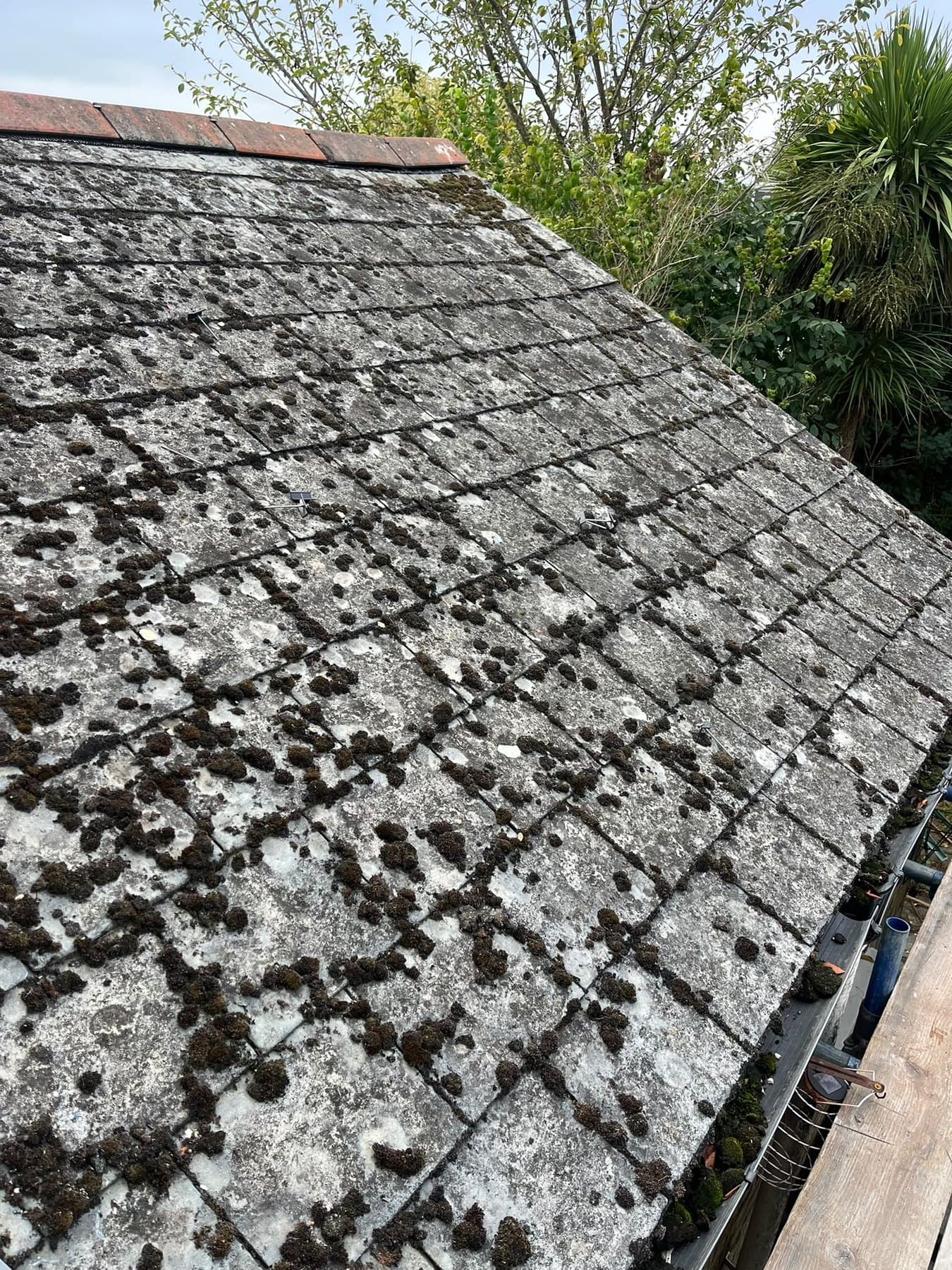
The short version is that a light growth of moss is normal on a north-facing slope in Kent and is not worth panicking about, but a thick mat of it is doing three things at once. It holds moisture where the covering wants to dry, it forces its way into the laps between tiles, and it breaks off in heavy rain and blocks the gutters below. Left long enough that combination takes years off a roof that was otherwise fine.
What moss actually does to a covering
The damage is mechanical and it is slow. Moss grows in the small gap where one tile laps the one below, and as it thickens it lifts the tile very slightly. That opens the lap, which lets more water and more debris in, which grows more moss. It is a loop that accelerates.
Then there is freeze and thaw. Wet moss sitting in a lap freezes, expands and pushes the tile a fraction further. Freeze and thaw damage is cumulative and stepped rather than gradual, so nothing happens for years and then several tiles move in one cold spell. That is why tiles slip after a hard winter rather than during the storm everyone blames.
On older concrete tiles there is a third effect. Moss holds moisture against a surface that was never meant to stay wet, and the face of the tile erodes faster because of it. That one is genuinely a lifespan question rather than an appearance one.
The gutter problem, which is usually the expensive bit
This is the part homeowners underestimate, and it is the reason moss costs money long before it costs tiles.
Moss does not stay on the roof. It comes off in heavy rain, slides down the slope and lands in the gutter, where it forms a dense wet mat that water cannot get through. A blocked gutter overflows behind the fascia rather than over the front, so the water goes into the timber and the wall rather than onto the path where you would see it.
That means a moss problem often presents as a damp wall or a rotten fascia rather than as anything on the roof. If you are seeing the warning signs of a blocked gutter, moss on the slope above is one of the first things worth checking, and it is why clearing gutters twice a year matters more on a mossy roof than on a clean one.
Why the coast and the inland behave differently
Our patch runs from sheltered, tree-heavy inland Ashford out to the open coast at Dymchurch and Lydd, all within about twenty minutes of the yard at Shadoxhurst, and what fills a gutter is completely different at the two ends.
Inland, around Ashford, it is leaves. The trees are the problem, the schedule follows them, and moss is a secondary issue on shaded slopes. Out on the Marsh there are far fewer trees, so what blocks a gutter is moss coming down off the roof along with wind-blown grit and salt. Same symptom, different cause, different timing.
Salt matters in a second way too. It breaks down mortar and surface coatings faster near the sea, which gives moss a rougher, more porous surface to take hold on. So a coastal roof often carries more moss than a sheltered inland one despite getting more sun and wind, which surprises people.
Getting it off without doing more harm than the moss
This is where a lot of roofs get damaged, and it is worth being blunt about it.
A pressure washer will strip moss off a roof very effectively and will also strip the surface off the tiles, drive water up under the laps and blow the bedding out of a mortar ridge. We will not do it, and we would be wary of anyone offering it as a quick fix. The damage does not show for a year or two, which is exactly why the practice survives.
In our experience, scraping moss off by hand and then treating the roof works better than pressure washing it, because the hand work removes the mass without touching the tile surface, and the treatment kills what is left so it does not simply grow back into the same laps within two seasons. It takes longer and it is the only version that leaves the roof better than it found it.
The other thing worth saying is not to do it yourself. A mossy roof is a slippery roof, ladder work on a wet slope is how people get seriously hurt, and the HSE guidance on using a ladder safely is worth reading before anyone goes up. There is nothing on a roof worth a fall.
When it is worth doing, and when it is not
A thin green film on a north slope is not a job. It will come back, it is doing no real harm, and cleaning it is buying appearance rather than years.
Worth doing is a thick mat you can see from the ground, moss visibly sitting proud of the laps, or gutters that fill with green material every autumn. At that point roof cleaning is genuine maintenance rather than cosmetics, and it pairs sensibly with a gutter clear and a look at the ridge while access is already set up, which costs far less than three separate visits.
It is also worth a look at what is causing it. Overhanging branches keep a slope permanently shaded and damp, and cutting them back does more for the roof than cleaning it twice. Ordinary tile maintenance and keeping the guttering and fascias clear will keep most roofs on the right side of this without much effort.
Talking to us
So, algae is a stain and moss is a slow mechanical problem, and the honest advice on a light growth is usually to leave it alone. When it is thick enough to sit in the laps and fill the gutters, it is worth dealing with properly rather than blasting it off.
Premier Roofing is family run, owned by Ken Perkins and working out of Shadoxhurst just outside Ashford, covering Romney, New Romney, Dymchurch, Lydd, Hythe and Ashford. Between us we have over ten years in the trade and list 44 separate roofing skills, moss removal and roof cleaning among them, and we have held ten out of ten across every review on our Checkatrade profile since joining in September 2024, on jobs across TN25, TN26 and ME14.
Quotes are free and carry no obligation, our workmanship is backed by a one thousand pound guarantee, and we will tell you honestly if your roof does not need cleaning. Work from across the patch is in our gallery. To have a mossy roof looked at before winter, call 01233 234554, email premier_roofing@hotmail.com or send us a message.