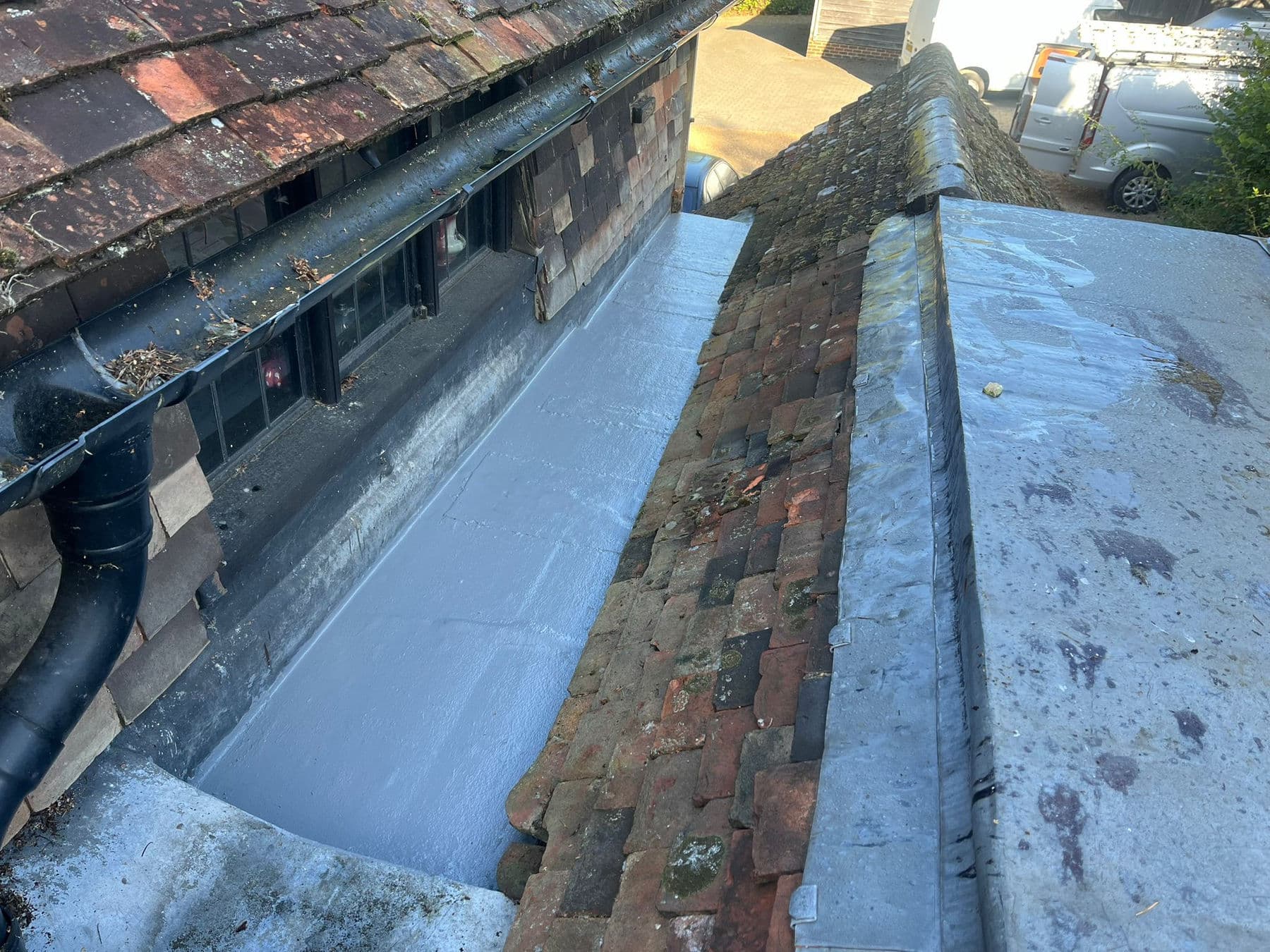
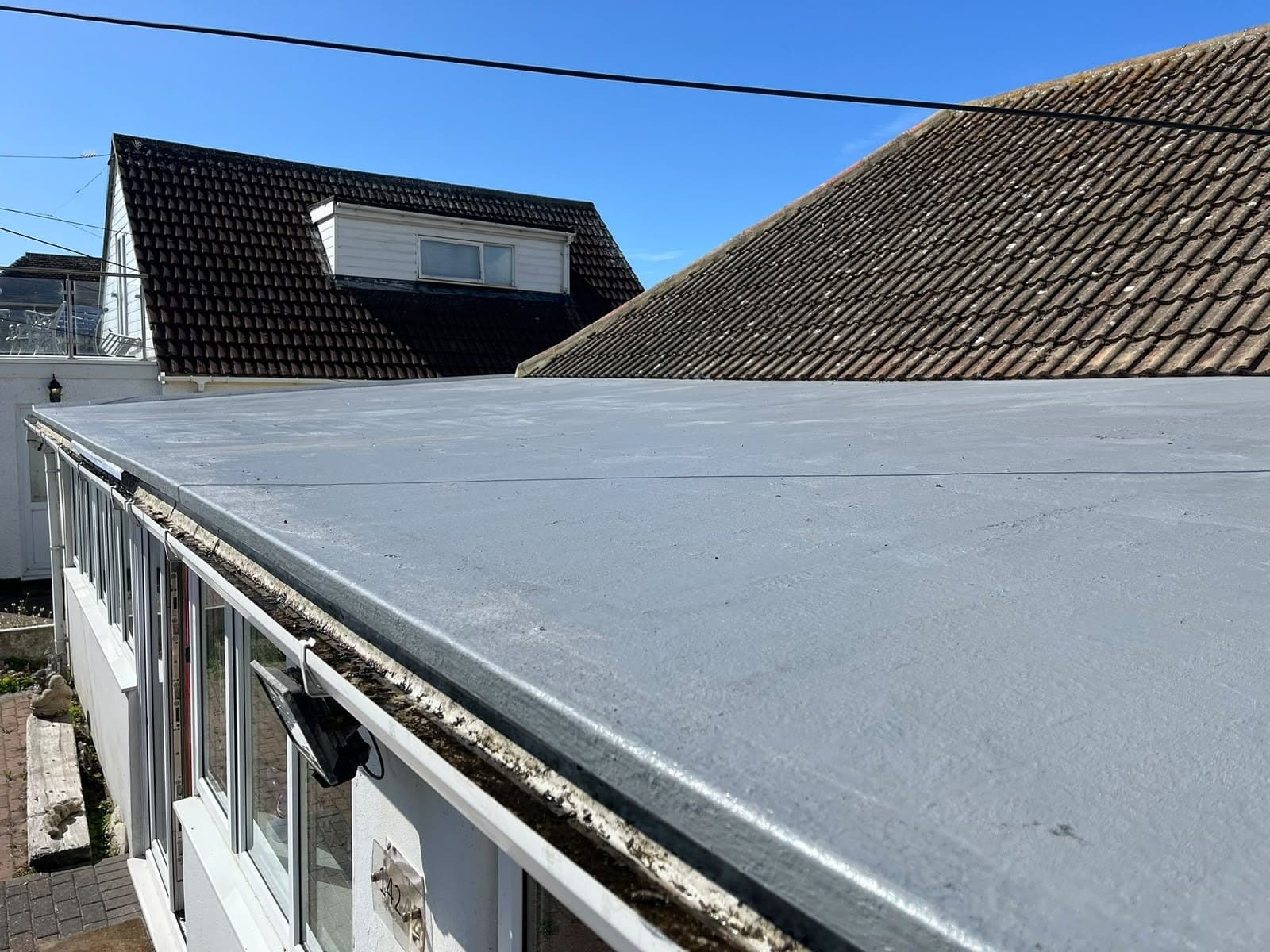
A flat roof drains because it is not actually flat. It is laid to a gentle slope, called the fall, which should end up at no less than 1 in 80 once the roof is finished, and that slope carries rain to an outlet, a gutter or a scupper and from there into a downpipe. When any link in that chain fails, the water sits on the roof instead of leaving it, and standing water is behind a good many flat roof leaks.
So flat roof drainage is really three things working together. The fall moves the water, the outlets take it off the roof, and the gutters and pipes carry it away. Each can fail on its own, and the fix depends on which it is.
Why a flat roof is never truly flat
The British Standard for flat roofs, BS 6229, treats anything pitched at 10 degrees or less as a flat roof, and asks for a finished fall of at least 1 in 80. That is 12.5 millimetres of drop for every metre of roof, so on a typical four metre deep extension the back edge sits about 50 millimetres higher than the front. Enough to move water, not enough to see.
Roofs are normally designed steeper than that. LABC Warranty's technical guidance on ponding describes design falls of 1 in 40 to achieve 1 in 80 in service as normal practice, because timber deflects under load, buildings settle and nothing is ever built to the exact millimetre. Design for the minimum and a roof is level within a few years.
The fall is created in one of two ways. On most timber roofs it comes from firrings, tapered strips of timber fixed along the top of each joist so that the deck laid over them slopes. On warm roofs it more often comes from tapered insulation boards, cut so that the insulation itself provides the slope. Either way, the fall has to be built into the structure underneath. A waterproof layer follows whatever shape it is laid on and cannot create a fall of its own.
Where the water goes
Once the fall has done its job, the water has to leave the roof somewhere, and there are three common ways it does.
The simplest is straight off the low edge into an ordinary gutter, which is how most extensions, garages and dormers work. Here the guttering is part of the roof drainage, and a blocked or sagging run backs water up onto the edge of the roof itself, which is often where the trouble starts on an extension that otherwise looks fine.
Where a roof is surrounded by a raised wall, called a parapet, the water leaves through a scupper, an opening through the parapet that drops into a hopper head and a downpipe on the outside. Larger roofs, including most commercial roofs, use internal outlets instead, set into the deck and draining through a pipe inside the building.
Parapet roofs need one more thing. Because the water has nowhere else to go, a blocked outlet fills the roof like a tray until it reaches the top of the upstands. A properly designed roof carries an overflow set a little higher than the outlet, so a blockage shows itself as water pouring from an unexpected place rather than as a ceiling coming down.
What ponding actually does
Ponding is water left standing on the roof after the rest of it has drained. The odd shallow puddle that dries in an afternoon is not a crisis, but water that lingers does real harm, and the LABC Warranty guidance sets out why.
The first is weight. A square metre of water one millimetre deep weighs a kilogram, so a pond 25 millimetres deep over 20 square metres adds about 500 kilograms to the roof. That weight makes the deck sag a little further, the deeper dip holds more water, and the cycle feeds itself until something gives.
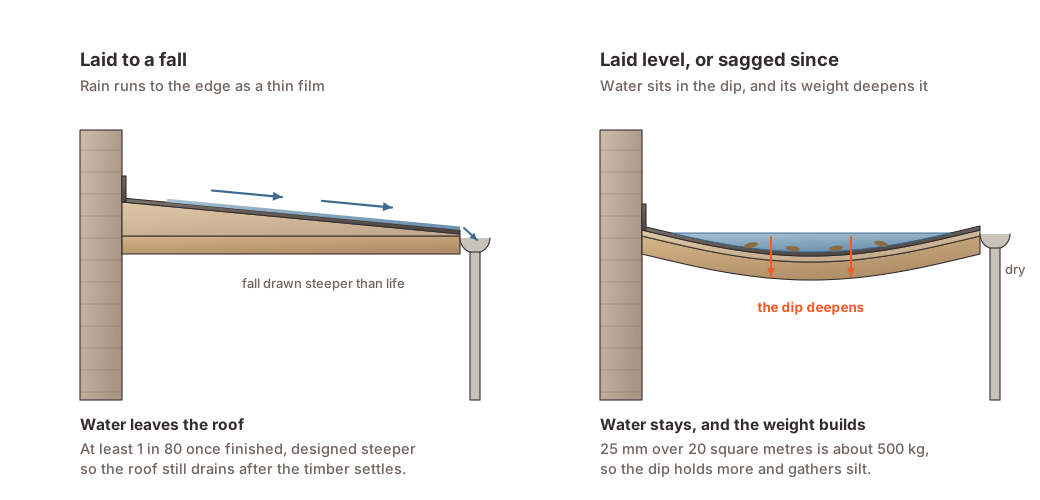
The second is pressure. A puncture under a pond has a head of water pushing through it, so the leak is faster and the damage below worse. The third is dirt. Standing water collects silt, leaves and algae, which loosen, wash to the outlet and block it, making the next pond bigger. Freeze and thaw is the fourth, because a membrane frozen under a puddle cannot move with the rest of the roof as it warms.
Why re-covering will not cure it
This is the part that catches people out. If a flat roof ponds, putting a new covering over it gives you a new covering with the same pond on it, and the guidance from the liquid roofing trade body says as much in plain terms. Re-waterproofing an existing roof does not deal with a ponding problem that was already there.
The fix is to change the shape of the roof or how it drains. That usually means correcting the falls with firrings or a tapered insulation overlay, adding an outlet, or building a small raised ridge, known as a cricket, behind anything that interrupts the flow, such as a rooflight upstand.
Building the fall back in while the old covering is off usually works better than adding an extra outlet in the middle of the dip, because an outlet only drains a puddle down to the level of its own rim, and the low spot around it carries on collecting silt until that blocks as well. It costs a little more on the day and saves the roof from failing the same way within a few years.
Poor drainage sits behind several of the most common flat roof problems, from a sagging deck to moss and debris piling up at the outlets, so a roof that has started to fail in more than one way is often a roof that never drained properly. When a flat roof is due for replacement anyway, that is the cheapest moment there will ever be to put its falls right.
Flat roofs around the Marsh
Two places on our patch make the point well. At Camber there are more flat roofs than in the villages around it, and that is a planning outcome rather than a fashion, because Rother District Council's own village planning document asks developers to consider forgoing a pitched roof to keep the skyline low. The village also sits beside an accreting dune system. We have not seen what windblown sand does to a roof studied and will not claim to know, but the outlets, gutters and valleys there are worth checking as a matter of course, because that is where anything windborne ends up.
At Dymchurch an exposed flat roof takes wind lifting at its edges as well as water sitting in its middle, so the upstands and outlets matter as much as the surface. It is the reason so many flat roof repairs in Kent turn out to be at an edge or an outlet rather than out in the open middle of the roof.
Keeping a flat roof draining
Most drainage problems start small and are cheap to deal with early. Clear outlets, hopper heads and gutters in autumn and after any big storm, and fit a leaf guard to any outlet near trees. After heavy rain, look at the roof from an upstairs window once the street has dried. Water still sitting there is ponding, and worth having looked at before the deck takes its shape.
Do not walk on the roof to check it. Many flat roofs are not built to take foot traffic, and a boot through a soft deck turns a drainage problem into a structural one. And if a roof has ponded for years despite every repair, it may be worth asking whether a flat roof or a pitched one is the better answer for that part of the house.
Talking to us about your flat roof
Ponding is one of the few flat roof faults you can see from a window, and one of the few that gets steadily worse on its own. Premier Roofing and Building Kent Ltd will look at the falls, the outlets and the gutters together and tell you which of them is actually the problem, so you are not paying to re-cover a roof whose real fault is its shape.
We are a family run firm at Shadoxhurst, just outside Ashford, with over ten years in the trade, and flat roofing is part of the work, in felt and in fibreglass, some of which you can see in our gallery. Every review on our Checkatrade profile scores ten out of ten, and we cover Ashford, Romney Marsh and the coast from Hythe to Rye.
Every quote is free, itemised in writing and carries no obligation, and our work is backed by a one thousand pound guarantee. If water is sitting on your roof, call 01233 234554, email premier_roofing@hotmail.com or send us a message and we will come and look.