Flashing is the material that seals every joint where a roof meets something that is not a roof. A chimney, a wall, an abutment, a valley between two slopes, a soil pipe coming through the covering. Tiles and slates keep water out of the open field of a roof, and flashing keeps it out everywhere they stop, which is why the great majority of leaks we are called to are flashing failures rather than holes in the covering.
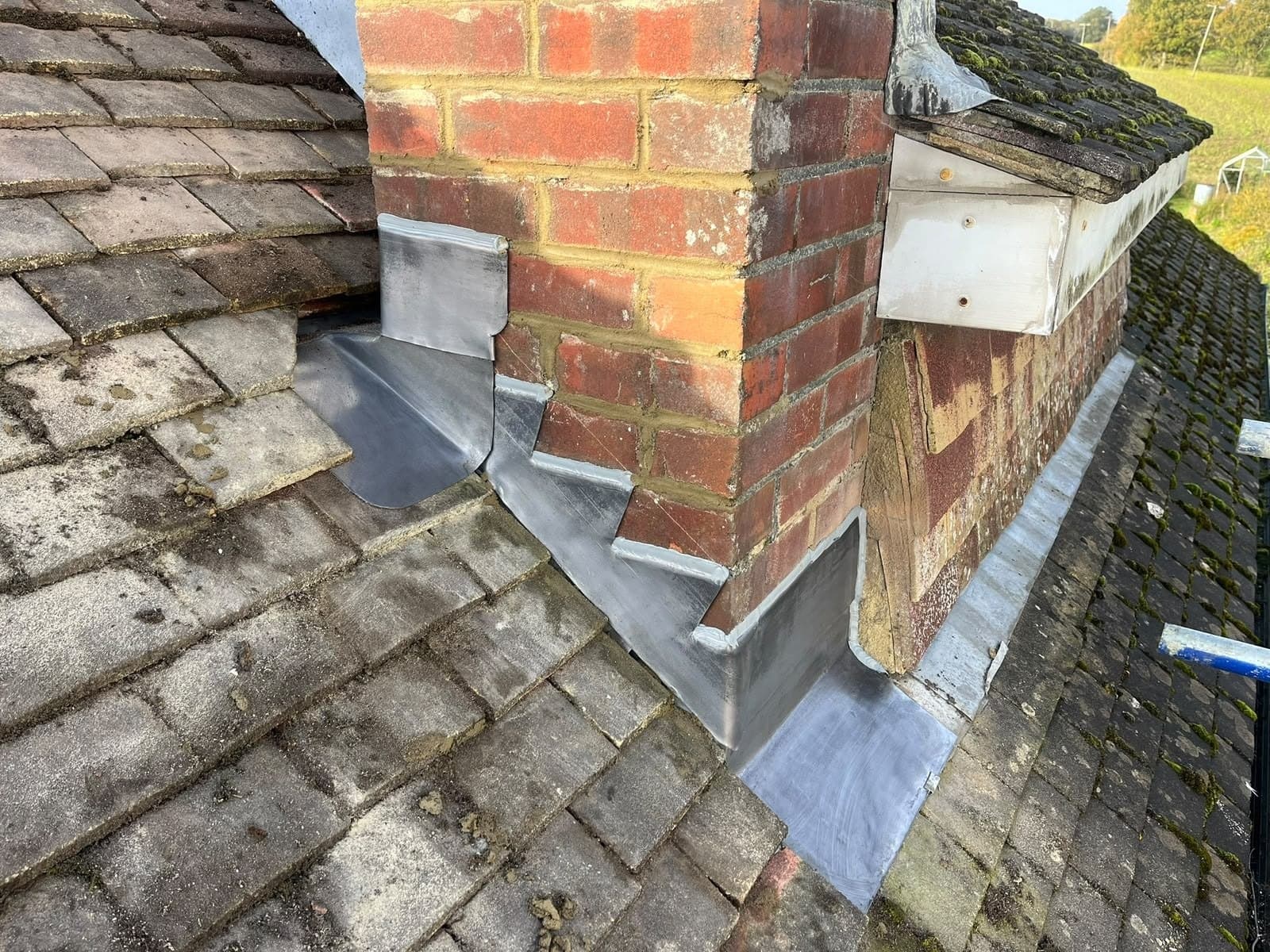
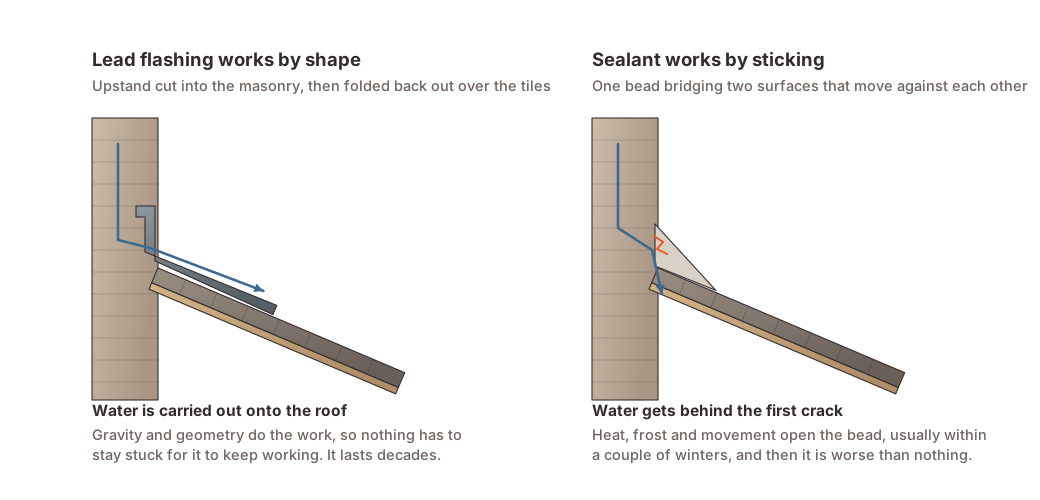
It is nearly always lead, and it works by shape rather than by stickiness. A properly formed flashing has an upstand tucked into a groove cut in the masonry, then folds back out and lays over the tiles below, so water running down the wall is caught and carried out onto the roof surface. Nothing about that depends on a seal or an adhesive holding. That distinction is the whole subject, because it is why good flashing lasts decades and why a bead of sealant across the same joint does not.
Where flashing lives on a typical house
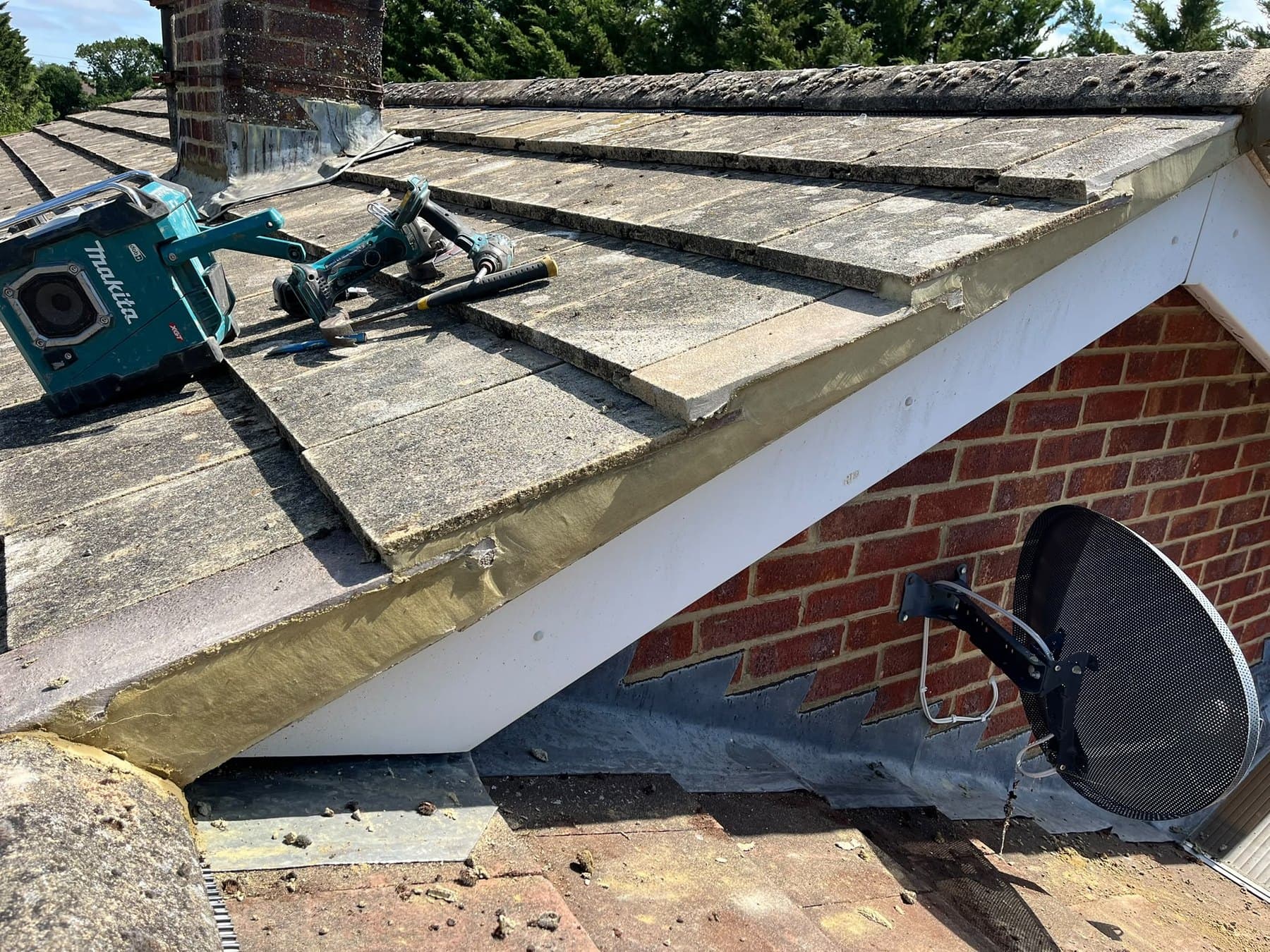
The most familiar one is around a chimney, and chimneys are the hardest case on any roof. A chimney is heated from inside, exposed on all four sides, and moves independently of the roof structure around it, so the joint between the two is being worked constantly. That is why chimney repairs so often turn out to be flashing repairs once somebody is up there, and why so much of the chimney work we do in Kent involves lead rather than brick.
Flashing also runs along abutments, where a roof meets a wall, such as where an extension meets the main house. It forms the valley between two slopes that meet at an angle, which is one of the highest volume water paths on any roof. And it seals around anything that penetrates the covering.
Why it fails long before it looks like it has
This is the part worth knowing as a homeowner. Flashing usually fails invisibly. Lead moves with temperature, and a length that is too long for its own expansion works itself loose at the fixings over years. A mortar joint holding an upstand weathers back. A previous repair in sealant hardens, shrinks and cracks.
None of that shows from the ground. What shows is a damp patch on a bedroom ceiling one winter, by which time water has been getting into the roof structure for a while. From working with clients across Kent we have found that flashing tends to fail before there is any visible damage at all, which is exactly why it belongs on an inspection list rather than a repair list. Knowing what a leak actually looks like is worth more here than on almost any other part of a roof.
Why sealant is not flashing
Everyone has seen a chimney with a grey or black line squeezed along the joint. Sometimes it is a genuine emergency measure to get through a wet week, which is fair enough. Very often it is a cheap alternative to doing the job.
The problem is structural rather than a matter of quality. Sealant relies on adhesion to two surfaces that are moving relative to each other in a joint that gets wet, hot and freezing in turn. Lead relies on gravity and geometry, which do not degrade. Once you understand that, the fact that a sealed joint reopens within a couple of winters stops being surprising.
The detail that separates a good job from a quick one
On a tiled roof running up against a wall, the better way is not one long strip of lead. It is a set of small individual pieces, one to each course of tiles, with a separate cover flashing laid over the top of them.
In our experience, lead soakers with a separate cover flashing work better than a single continuous flashing on a tiled abutment, because each soaker moves with its own course independently, so ordinary thermal movement is absorbed a course at a time rather than being concentrated into one long strip that eventually splits at its weakest point. It is slower to fit and it is the reason some abutments are still watertight after forty years while others need doing again in eight.
The same logic explains why the length of any individual piece matters, why the upstand needs a proper chase in the masonry rather than being wedged into a weathered mortar joint, and why the whole thing should be dressed rather than forced.
What this coast does to leadwork
Our patch runs from sheltered inland Ashford out to the exposed coast at Hythe, Dymchurch and Lydd, and leadwork is one of the few parts of a roof that copes with that range well.
Lead itself is unbothered by salt air, which is one reason it has been the standard for centuries and why it is still the right answer on a coastal roof. What does not cope is everything around it. Ferrous fixings and clips corrode far faster near the sea, and salt breaks down mortar and coatings more quickly too, so it is the fixings and the pointing holding a flashing in place that give out rather than the lead. We use stainless as standard on exposed coastal work for that reason. On leadwork specifically it matters, because a sound flashing that has lost its fixings is no longer a flashing.
When to look at it
Flashing is not something to inspect after a problem, because by then the roof structure has already been wet. It belongs in a routine check along with the ridge and the gutters, and it is the item most worth asking about specifically, since it is the thing least likely to be visible from the ground.
If a roofer is already up there for something else, having the flashings looked at costs almost nothing extra, whereas leaving a known problem never costs only what the repair would have cost. Flashing is one of the few things on a roof where the difference between a good job and a poor one is invisible for years and then total, so it is worth asking any roofer what they intend to fit and how. The NFRC's guidance on choosing a roofer is a reasonable independent starting point for those questions. A sensible inspection routine will catch a tired flashing years before a ceiling does.
Talking to us
Premier Roofing is family run, owned by Ken Perkins and working out of Shadoxhurst just outside Ashford, covering Romney, New Romney, Dymchurch, Lydd, Hythe and Ashford. Between us we have over ten years in the trade and list 44 separate roofing skills, and leadwork and flashing is one of them rather than something we subcontract. We have held ten out of ten across every review on our Checkatrade profile since joining in September 2024, on jobs including chimney repair across TN25, TN26 and ME14.
Quotes are free and carry no obligation, our workmanship is backed by a one thousand pound guarantee, and there is a 24 hour call-out if water is coming in now. Leadwork and chimney jobs from across the patch are in our gallery, including valleys and abutments photographed while the lead was going on. To have your flashings looked at, call 01233 234554, email premier_roofing@hotmail.com or send us a message.